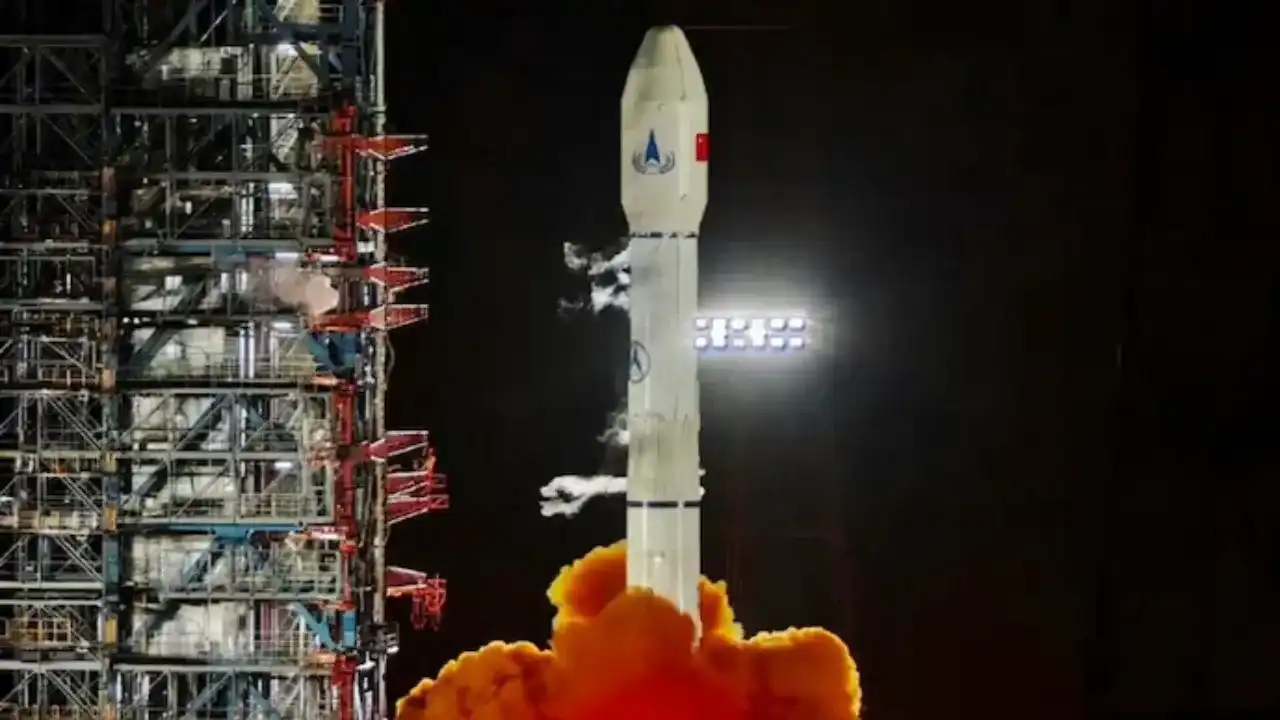
China launches Tianwen-2 on a first mission to retrieve samples from asteroid Kamoʻoalewa
China launched its first mission to retrieve samples from a nearby asteroid on Thursday with the nighttime liftoff of the Tianwen-2 spacecraft. This ambitious endeavor marks China as the third nation to successfully collect asteroid material.
The mission, which spans a decade, follows China's recent achievements in space exploration, including landing robots on the far side of the moon, operating a national space station, and planning human missions to the moon by 2030.
The Long March 3B rocket took off at approximately 1:31 a.m. from the Xichang satellite launch center, carrying the Tianwen-2 robotic probe. Over the next year, the spacecraft will approach the near-Earth asteroid 469219 Kamoʻoalewa, located between 9 million and 24 million miles (15 million to 39 million kilometers) away.
According to China's official news agency Xinhua, the launch was a "complete success." Tianwen-2 is expected to reach Kamoʻoalewa in July 2026, collect samples, and return them to Earth by November 2027. Afterward, it will head to its second target, the main-belt comet 311P/PanSTARRS, on a multi-year journey.
Comet 311P, found in the asteroid belt between Mars and Jupiter, is closer to the Sun than typical comets, which may affect its surface characteristics, particularly the presence of ice. The mission will conduct detailed studies of both Kamoʻoalewa and 311P, including the material ejected by the comet.
Sampling Kamoʻoalewa presents more challenges than China's previous lunar missions due to the asteroid's lower gravity, complicating landing and collection efforts. Japan's Hayabusa was the first mission to retrieve samples from an asteroid in 2010, followed by the Ryugu mission in 2019. The U.S. mission OSIRIS-REx successfully returned samples from the Bennu asteroid in 2020.
Kamoʻoalewa is classified as a quasi-satellite of Earth, having orbited the Sun for around a century, with a size ranging from 120 to 300 feet (40 to 100 meters). Tianwen-2 follows the Tianwen-1 mission, which was China's first Mars mission, successfully landing on Utopia Planitia in 2021.
Looking ahead, China is planning its third interplanetary mission, Tianwen-3, tentatively set for 2028, which could make it the first country to retrieve samples from Mars. Last month, the China National Space Administration (CNSA) announced a payload capacity of 20 kg (44 lb) for international research institutions on the Mars orbiter and lander.