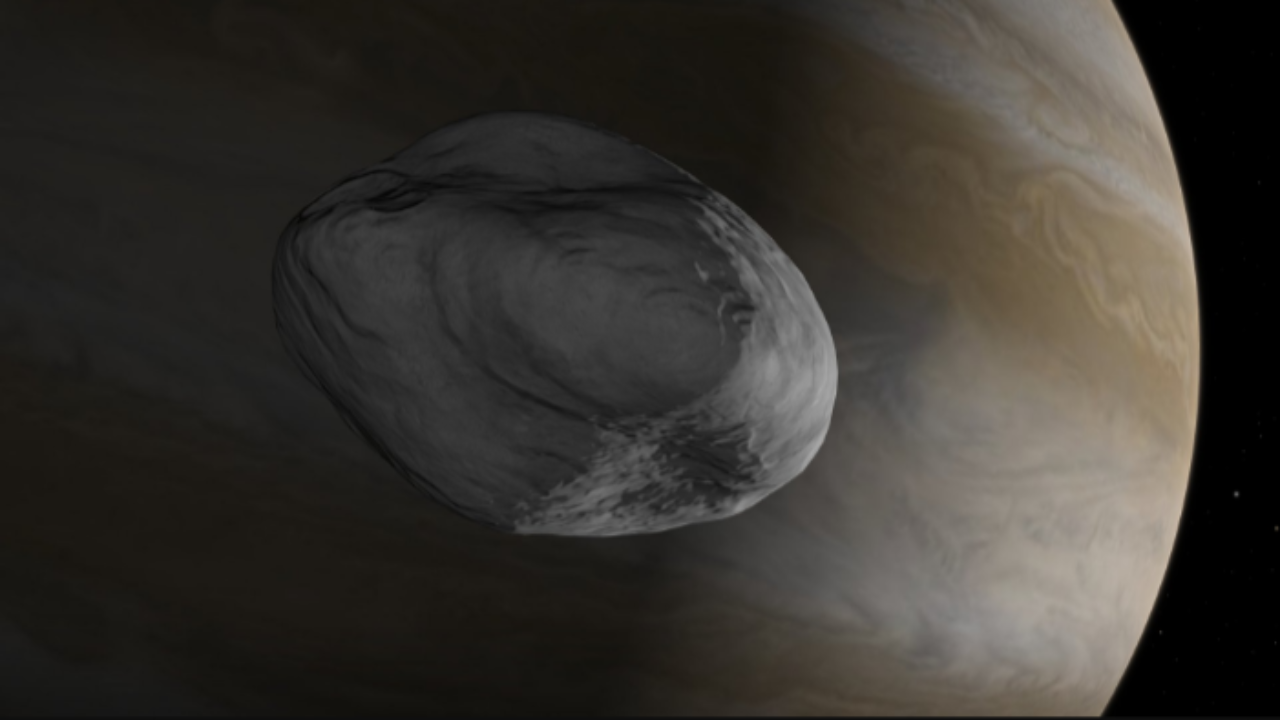
NASA's Juno spacecraft spots Amalthea, a moon orbiting Jupiter's Great Red Spot
NASA's Juno spacecraft has unveiled a captivating image showcasing the presence of Amalthea, a minuscule moon gracefully encircling the colossal gas giant, Jupiter.
Despite its size, Amalthea boasts a striking feature—it holds the title of being the solar system's reddest object.
Astronomers attribute this vibrant hue to the influence of sulfur emanating from the Io, a neighboring Jovian moon renowned for its volcanic activity.
Images released this week were taken by NASA's Juno spacecraft during its 59th close flyby of Jupiter, at a distance of about 165,000 miles above the planet's clouds. Citizen scientist Gerald Eichstädt processed the raw camera data to enhance the clarity of the pictures.
The Juno spacecraft features the JunoCam instrument, which not only captures high-resolution images of Jupiter but also involves the public in the mission. Citizens are invited to process the camera's images and provide input on what to focus on next.
Juno, orbiting Jupiter for over seven years, is on a mission to study the planet's origin, evolution, and various aspects. It aims to find Jupiter's core, map its magnetic field, measure atmospheric water and ammonia, observe auroras, and study Jupiter's moons and dust rings.
During its primary mission, Juno collected data revealing that Jupiter's atmospheric weather layer extends beyond its visible water clouds, expanding our understanding of the planet's dynamics.
Juno, after completing 35 orbits, is now studying the entire Jupiter system, including its rings and moons, as part of its extended mission. The spacecraft is expected to continue its operations for another year or until it ceases to function. Eventually, Juno will burn up in Jupiter's atmosphere to prevent any potential contamination of the planet's potentially habitable moons.
Amalthea, one of Jupiter's 95 official moons, was initially spotted by Edward Emerson Barnard in 1892. Measuring approximately 100 miles in width,
Amalthea has an irregular, potato-like shape due to its insufficient mass to form a more symmetrical sphere. Nearly a quarter-century ago, scientists had the opportunity to observe this small moon in detail with the assistance of NASA's Galileo spacecraft.
The close-up images captured by Galileo unveiled a chaotic terrain adorned with craters, hills, and valleys, providing a glimpse into the intriguing and diverse features of Amalthea's surface.
Amalthea is within the orbit of Io, the closest of Jupiter's four large moons, along with three other oddly shaped mini moons: Metis, Adrastea, and Thebe. It's so close to Jupiter, in fact, it only takes Amalthea half of a day on Earth to circle its planet.