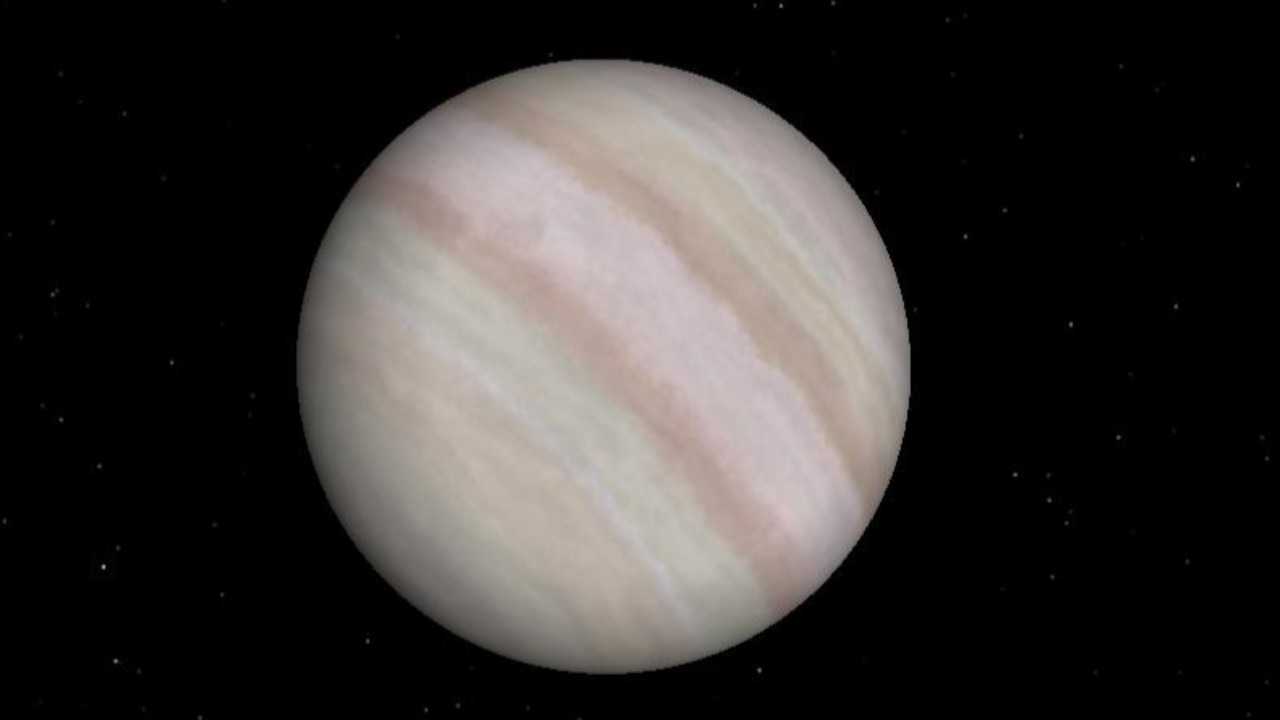
WASP-17 b, an Exoplanet so Hot it has Clouds Made of Quartz
A recent study published in The Astrophysical Journal Letters used data obtained by the James Webb Space Telescope’s (JWST) Mid-Infrared Instrument (MIRI) to identify the presence of quartz nanocrystals in the upper atmosphere of WASP-17 b, an exoplanet whose mass and radius are approximately 0.78 and 1.87 that of Jupiter, respectively, and is located approximately 1,324 light-years from Earth. WASP-17 b is classified as a “puffy” hot Jupiter due to its 3.7-day orbital period, meaning the extreme temperatures could cause unique chemical processes to occur within its atmosphere, but the astronomers were still surprised by the findings.
Dr. David Grant, who is a researcher at the University of Bristol in the UK and lead author of the study, which is comprised of more than three dozen co-authors explains: “We knew from Hubble observations that there must be aerosols—tiny particles making up clouds or haze—in WASP-17 b’s atmosphere, but we didn’t expect them to be made of quartz.”
What makes this discovery unique is that exoplanets have traditionally been found to possess magnesium-rich silicates such as pyroxene or olivine, but the discovery of just quartz within an exoplanet’s atmosphere by JWST’s MIRI could provide new insights into the formation and evolution of exoplanet clouds and their respective atmospheres. Additionally, while the shape of these quartz crystals could mimic those found on the Earth, their size is strikingly different at only 10 nanometers in diameter, or one-millionth of a centimeter, while the average quartz crystal on Earth is a few centimeters in diameter, with the largest documented single quartz crystal being 6.1 meters by 1.5 meters by 1.5 meters and weighing 39,916 kilograms.
Discovered in 2009, WASP-17 b is the first exoplanet found to exhibit a retrograde orbit, meaning it orbits in the opposite direction of its star’s rotation, with a 2013 study identifying water in its atmosphere and another study finding sodium. Due to its mass being less than Jupiter but a volume greater than seven times, WASP-17 b is currently classified as one of the puffiest exoplanets ever found.
While quartz was identified in this most recent study, WASP-17b’s atmospheric composition mirrors traditional gas giant planets that exist both inside and outside our solar system, as it is primarily comprised of hydrogen and helium. WASP-17 b is also tidally locked with its parent star, meaning one side always faces the star. This means as the clouds circulate around the planet, they are vaporized on the dayside. However, astronomers are still trying to determine both the amount of quartz in the atmosphere along with the activity of the clouds.
How will these quartz crystals teach us about the formation and evolution of exoplanetary atmospheres in the coming years and decades? Only time will tell, and this is why we science!