Physicists Confirm a Third Type of Magnetism
A groundbreaking experiment in Sweden has successfully demonstrated control over a new form of magnetism, which could significantly enhance various electronic applications, including memory storage and energy efficiency. Researchers from the University of Nottingham used a device that accelerates electrons to high speeds, applying different polarizations of X-rays to an ultra-thin manganese telluride wafer. This approach revealed unique magnetic activities at the nanometer scale.
Typically, a mundane piece of iron can become magnetic when its particles are arranged so that unpaired electrons align based on a property known as "spin." This quantum characteristic can be thought of as having a directional push, akin to the spin of a ball, but with only two possible orientations: up and down.
According to Science Alert, in non-magnetic materials, spins exist in pairs—one up and one down—canceling each other out. In contrast, materials like iron and nickel allow unpaired electrons to align, creating a strong magnetic force, useful for tasks like picking up paper clips.
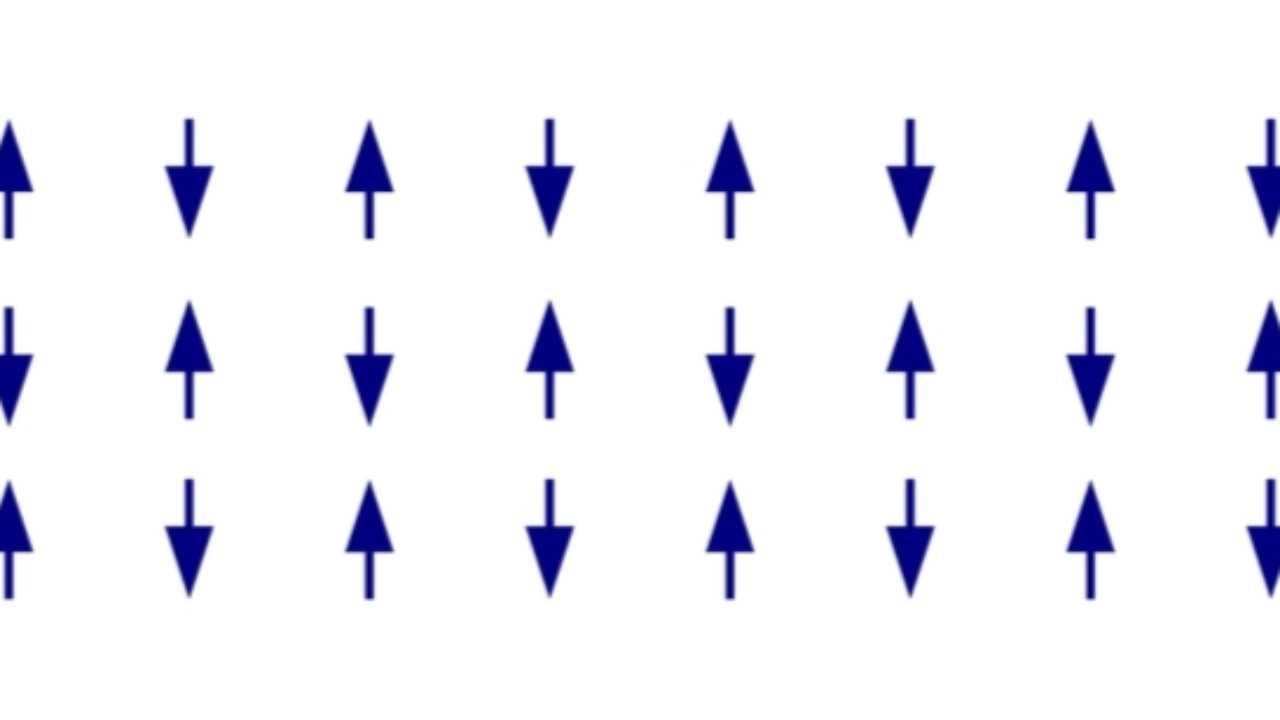
Interestingly, there’s also a form of magnetism known as antiferromagnetism, where the spins can cancel each other out, appearing inactive from a distance. This phenomenon has been explored for nearly a century. Recently, scientists theorized a third state, called altermagnetism, which involves particles arranged in a canceling manner similar to antiferromagnetism but with a slight rotation. This configuration generates distinct forces at the nanoscale, making it appealing for data storage and energy applications.
Peter Wadley, a physicist at the University of Nottingham, explains that in altermagnetism, magnetic moments point antiparallel to their neighbors, with each crystal segment rotated slightly. This subtle twist leads to significant implications for material properties.
The recent experiments have confirmed the existence of this altermagnetism and demonstrated the ability to manipulate its tiny magnetic vortices. Wadley and his team showed that they could intentionally distort a thin sheet of manganese telluride, creating distinct magnetic whirlpools on its surface. Using the synchrotron at the MAX IV Laboratory, they visualized altermagnetism in action.
Oliver Amin, who led the research, emphasizes the importance of bridging theoretical concepts with practical applications. Although these applications are still theoretical, they hold great promise for advancements in electronics and computing, particularly in spin-based memory systems and understanding superconducting currents. PhD student Alfred Dal Din expressed the rewarding nature of being among the first to study this new class of magnetic materials. This research was published in 'Nature'.