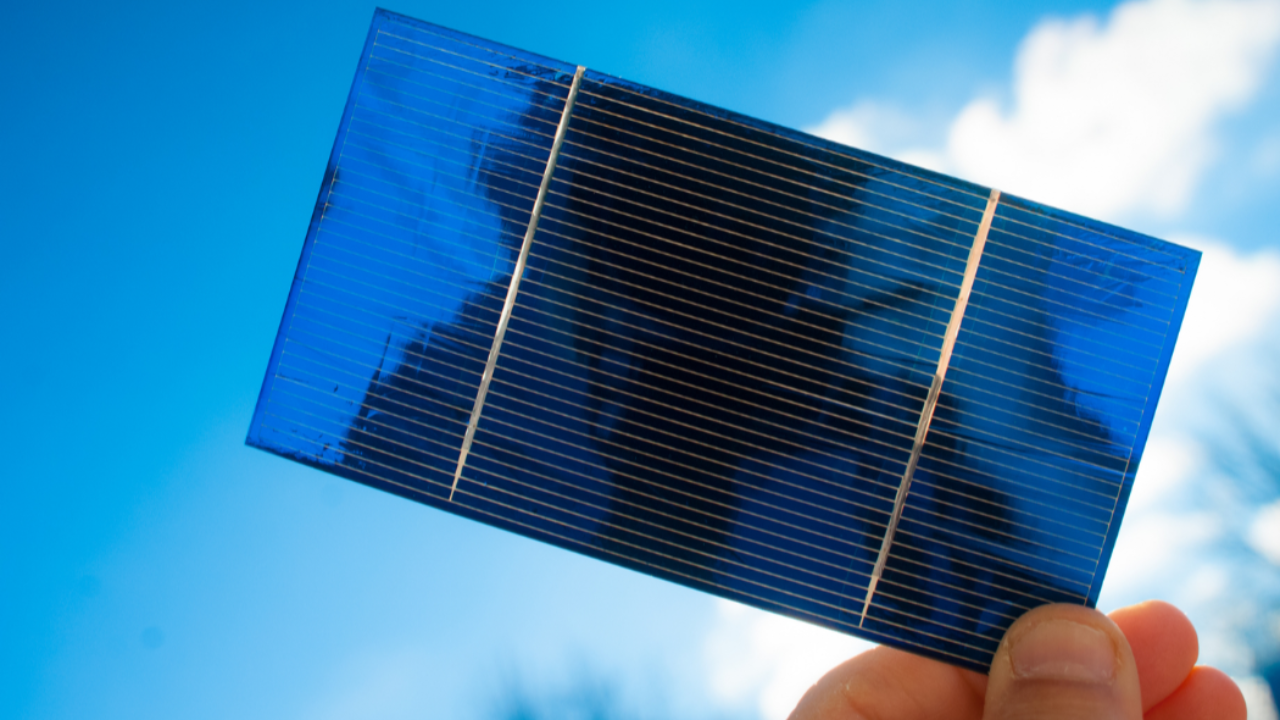
New cutting-edge solar panels are 1000x more powerful than traditional panels and could revolutionize the solar energy industry:
Researchers at Martin Luther University Halle-Wittenberg (MLU) have developed a new method to significantly increase the efficiency of solar cells by a factor of 1,000.
They achieved this breakthrough by creating alternating crystalline layers of barium titanate, strontium titanate, and calcium titanate.
This discovery, recently published in the journal Science Advances, has the potential to revolutionize the solar energy industry. By exploring new materials like barium titanate, which is a ferroelectric mixed oxide, researchers aim to overcome the efficiency limitations of silicon-based solar cells.
Ferroelectric materials generate electricity from light due to their asymmetric structure with separated charges. Unlike silicon, they don't need a pn junction for the photovoltaic effect, simplifying solar panel production.
However, pure barium titanate has limited sunlight absorption, leading to low photocurrent. Recent research demonstrates that combining thin layers of different materials greatly enhances solar energy yield.
Physicist Dr. Akash Bhatnagar from MLU's Centre for Innovation Competence SiLi-nano explains that the key aspect is alternating a ferroelectric material with a paraelectric material. While the paraelectric material may not have separated charges, it can exhibit ferroelectric properties under specific conditions, such as lower temperatures or slight modifications to its chemical structure.
Bhatnagar's research group made an interesting finding that the photovoltaic effect is significantly enhanced when the ferroelectric layer alternates not just with one, but with two different paraelectric layers.
Yeseul Yun, a PhD student at MLU and first author of the study, explained the process involved, stating: "We embedded the barium titanate between strontium titanate and calcium titanate.
This was achieved by vaporizing the crystals with a high-power laser and redepositing them on carrier substrates. This produced a material made of 500 layers that is about 200 nanometers thick."
During the photoelectric measurements, the researchers irradiated the new material with laser light. The results were surprising even to the research group.
They found that compared to pure barium titanate of similar thickness, the current flow in the new material was up to 1,000 times stronger.
This was achieved despite reducing the proportion of barium titanate, which is the main photoelectric component, by almost two-thirds.
Bhatnagar explained: "The interaction between the lattice layers appears to lead to a much higher permittivity - in other words, the electrons are able to flow much more easily due to the excitation by the light photons."
The measurements also revealed that this effect is highly stable, as it remained almost constant over a period of six months.
Further research is required to determine the precise cause behind this remarkable photoelectric effect.
However, Dr. Bhatnagar is optimistic that the potential demonstrated by this new concept can be effectively utilized for practical applications in solar panels.
"The layer structure shows a higher yield in all temperature ranges than pure ferroelectrics. The crystals are also significantly more durable and do not require special packaging."
This new development holds immense implications for the solar industry. The use of this new material in solar panels would result in significantly higher efficiency compared to silicon-based cells. Additionally, the production cost of these panels would be lower. Moreover, they would require less space to generate the same amount of electricity, making them particularly suitable for urban environments with limited space.
The discovery has already garnered attention from industry leaders. Dr. Jennifer Rupp, a professor at ETH Zurich who was not directly involved in the study, emphasized the significance of the findings, highlighting their importance for advancing solar cell technology.
"This is a very exciting discovery that could have a significant impact on the development of more efficient solar cells," said Rupp.
"The fact that the new material is also more durable and easier to produce than traditional silicon-based solar panels makes it even more promising."
Solar energy is one of the fastest-growing sources of renewable energy, and the demand for solar panels is expected to increase dramatically in the coming years.
According to the International Energy Agency, solar power is set to become the largest source of electricity by 2050, accounting for around one-third of global electricity generation. However, the efficiency of current solar panels needs to be improved if this is to become a reality.