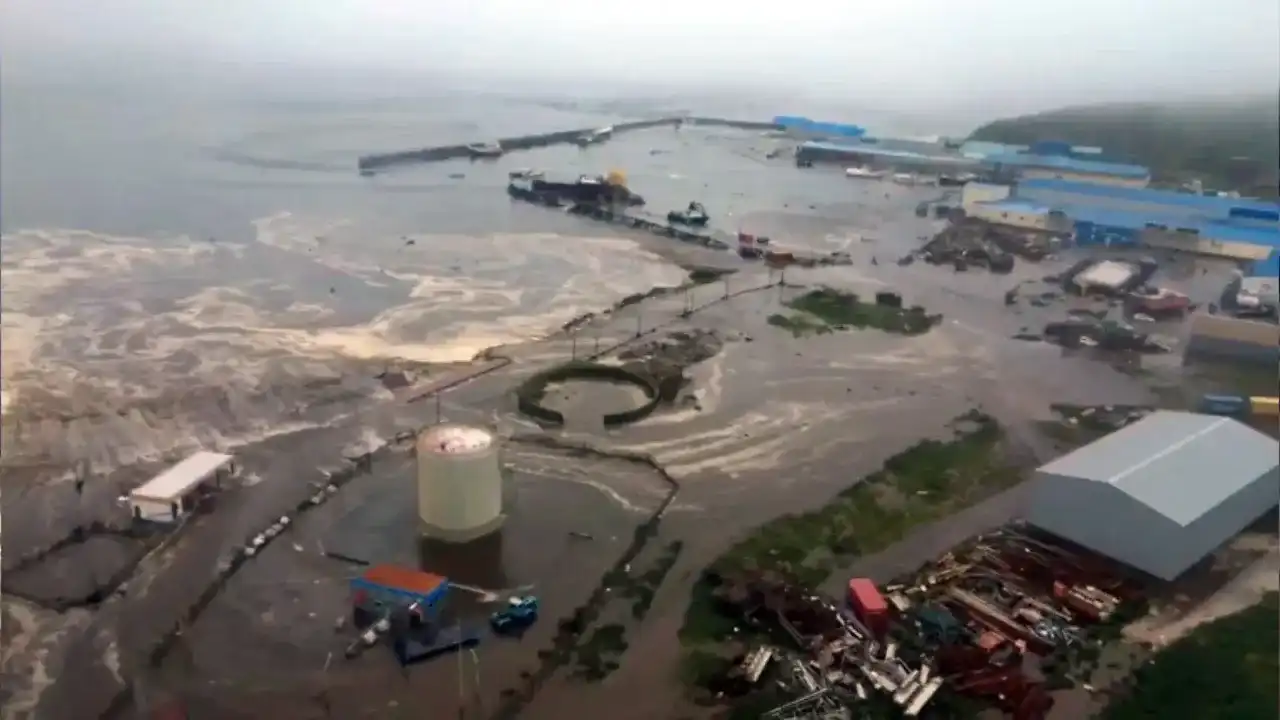
NASA's Guardian system successfully detects tsunami in real time after Kamchatka earthquake
In July 2025, scientists witnessed a historic event: the real-time tracking of a tsunami triggered by an 8.8 magnitude earthquake off the eastern coast of Russia's Kamchatka Peninsula. This powerful quake, the strongest in nearly 15 years, created a tsunami with waves racing outward at over 400 mph (644 km/h). Following the earthquake, millions, including about two million people in Japan, were evacuated as alarms sounded across the Pacific.
As the tsunami propagated, it caused disturbances in the atmosphere, impacting global satellite navigation signals. Thanks to a new component added to NASA's disaster alert system, known as Guardian, researchers received near-instant notifications that waves were heading toward Hawaii. This system, which had only recently integrated artificial intelligence, enabled officials to predict the tsunami’s arrival 30 to 40 minutes in advance.
Fortunately, the tsunami ultimately caused minimal damage when it reached Hawaii, with waves only peaking at 5 feet (1.7 meters) and resulting in minor flooding. Most of the tsunami's energy dissipated in the open ocean.
The Kamchatka earthquake showcased the potential of NASA’s Guardian system, which utilizes radio signals from satellites to detect atmospheric ripples caused by ocean disturbances. This technology has the capability to identify other major events, such as volcanic eruptions and underground nuclear tests, by measuring ionospheric changes.
Jeffrey Anderson, a data scientist involved in developing the Guardian system, noted that the technology enables real-time detection of tsunamis and other phenomena. Though the concept of using satellite navigation signals to detect tsunamis existed for decades, it was only with the implementation of Guardian that it became a practical reality.
Tsunamis typically begin as low waves (about 10-50 cm) in open water, making them nearly invisible. However, the vast movement of water displaces air and disturbs the atmosphere, which creates ripples in the ionosphere, a layer of charged particles high above the Earth’s surface. These disturbances alter the density of electrons in the ionosphere, which in turn affects satellite communication signals.
By analyzing delays in these signals, systems like Guardian can identify anomalies associated with tsunami activity. Scientists have retrospectively linked similar atmospheric disturbances to significant events like the 2011 Tohoku earthquake in Japan and the 2022 Tonga eruption, but the Kamchatka earthquake marked the first time a tsunami was tracked in real time using this innovative method.
The advances made during this incident highlight the potential for improved tsunami detection, which could ultimately provide better warnings and enhance public safety. This technology also raises possibilities for broader applications, ensuring that communities receive timely alerts for various natural disasters, possibly preventing catastrophic outcomes.
In summary, the successful tracking of the tsunami generated by the Kamchatka quake represents a significant leap in disaster preparedness technology and showcases the innovative use of existing satellite systems to enhance early warning capabilities.