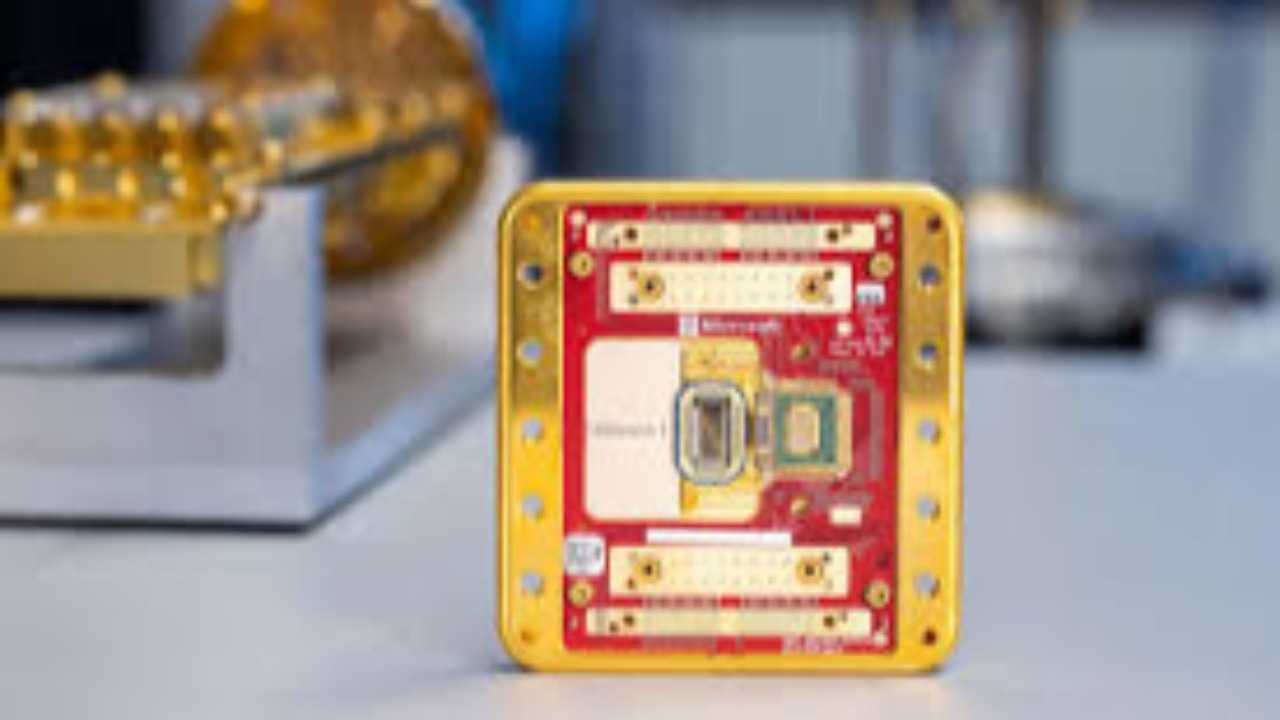
Microsoft’s new Majorana 1 processor could revolutionize quantum computing with 'topological qubits'
Researchers at Microsoft have announced a breakthrough in quantum computing with the creation of the first “topological qubits.”
This device, which stores information in an exotic state of matter, could significantly advance the field of quantum computing.
Alongside this announcement, the researchers published a paper in Nature and a “road map” for future work, detailing the design of the Majorana 1 processor, which is expected to accommodate up to a million qubits.
This capability could enable advancements in various applications, including cracking cryptographic codes and accelerating the design of new drugs and materials.
If Microsoft's claims are validated, the company may surpass competitors like IBM and Google, who are currently frontrunners in developing quantum computers.
However, the peer-reviewed paper in Nature only partially substantiates the researchers' claims, and the road map outlines several challenges that still need to be addressed.
While the Microsoft press release highlights what is purported to be quantum computing hardware, independent confirmation of its capabilities is still pending.
Nonetheless, the developments from Microsoft are viewed as highly promising.
Quantum Bits Are Hard to Build
Quantum computers were conceptualized in the 1980s as a revolutionary advancement in computing. Unlike ordinary computers that store information in bits (which can be either 0 or 1), quantum computers use quantum bits, or qubits.
Ordinary bits can represent a value of either 0 or 1, resembling an arrow that can only point either up or down. In contrast, a qubit can exist in a state of superposition, meaning it can represent both 0 and 1 simultaneously. Like an arrow, it can point in any direction, allowing it to embody multiple values at once.
This unique property of qubits enables quantum computers to perform specific calculations much faster than classical computers, particularly in tasks like cryptographic code-breaking and simulating complex natural systems.
However, creating effective qubits and managing the input and output of information is extremely challenging. One major difficulty arises from their susceptibility to environmental interference; interactions with the outside world can easily disrupt the fragile quantum states.
Researchers have explored various technologies to develop qubits, including using trapped atoms confined in electric fields to create stable quantum states and employing superconducting circuits with currents that flow without resistance to form qubits.
Tiny Wires and Exotic ParticlesMicrosoft has adopted a unique approach to developing its "topological qubits" by utilizing Majorana particles, which were first theorized in 1937 by Italian physicist Ettore Majorana. Unlike naturally occurring particles such as electrons or protons, Majorana particles exist only within a specific type of material known as a topological superconductor.
This material requires advanced design techniques and must be cooled to extremely low temperatures.
Because of their exotic nature, Majorana particles are typically studied in academic settings rather than being applied in practical technologies.
The Microsoft research team has devised a method using a pair of tiny wires, each containing a Majorana particle trapped at its ends, to function as a qubit.
They determine the qubit's value—indicated by whether an electron is present in one wire or the other—through microwave measurements.