Monumental art displayed in shade of Egypt's pyramids
Renowned international artists have brought contemporary art to the sands beneath the iconic pyramids of Giza, outside Cairo, in a unique fusion of history and modern creativity. The fifth edition of the exhibition Forever is Now is set to run until December 6, showcasing a range of striking installations that dialogue with the ancient monuments.
Italy’s 92-year-old Michelangelo Pistoletto, celebrated worldwide for his work Il Terzo Paradiso, has contributed a three-metre-tall mirrored obelisk surrounded by a series of sand blocks forming the mathematical symbol for infinity. "We have organized over 2,000 events across five continents in 60 countries," said Francesco Saverio Teruzzi, Pistoletto’s construction coordinator. "An estimated five million people have engaged with the message of the Third Paradise." Pistoletto’s installation at Giza continues his exploration of the harmony between art, society, and nature, reflecting both timelessness and global reach.
Franco-Beninese artist King Houndekpinkou presented White Totem of Light, a striking column constructed from ceramic fragments salvaged from a Cairo factory. Houndekpinkou described the experience as “an incredible opportunity to converse with 4,500 years—or even more—of history,” highlighting the resonance between contemporary creativity and Egypt’s ancient legacy.
South Korean artist Jongkyu Park took inspiration directly from the Great Pyramid, using its precise measurements to create geometric structures for his installation, Code of the Eternal. A thousand small cylindrical acrylic mirrors planted in the sand form a Morse code poem, imagining a symbolic dialogue between Tangun, the legendary founder of Korea’s first kingdom, and an Egyptian pharaoh, blending two distinct cultural mythologies.
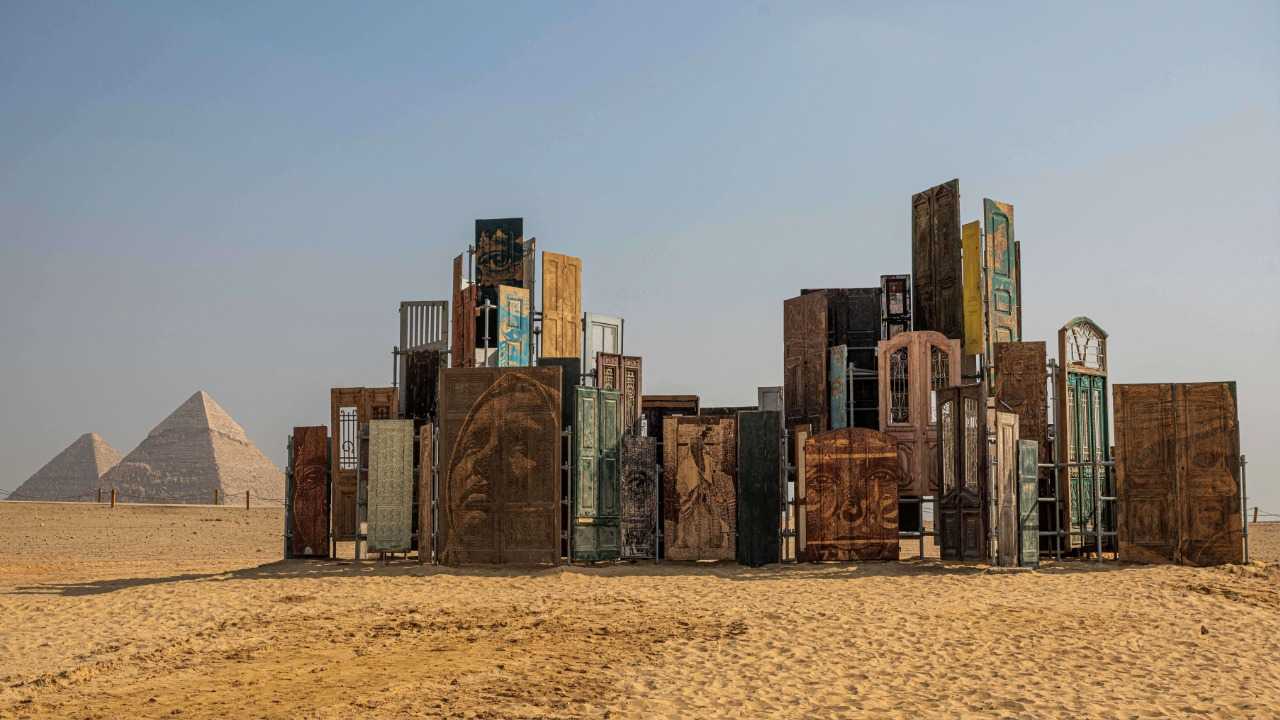
Portugal’s Alexandre Farto, widely known as Vhils, explored the archaeological and historical dimensions of the city through a bricolage of doors collected in Cairo and across the globe, evoking the layered process of excavation and memory.
Six additional artists contribute to the exhibition, each adding their own perspective on history, culture, and contemporary expression. These include Turkey’s Mert Ege Kose, Lebanon’s Nadim Karam, Brazil’s Ana Ferrari, Egypt’s Salha Al-Masry, and the Russian collective Recycle Group. Together, the works transform the sands near the Giza pyramids into a living gallery, where past and present intersect.
Forever is Now invites visitors to experience art not just as observation but as a dialogue across time, space, and culture, merging the ancient and the contemporary in an unforgettable setting.