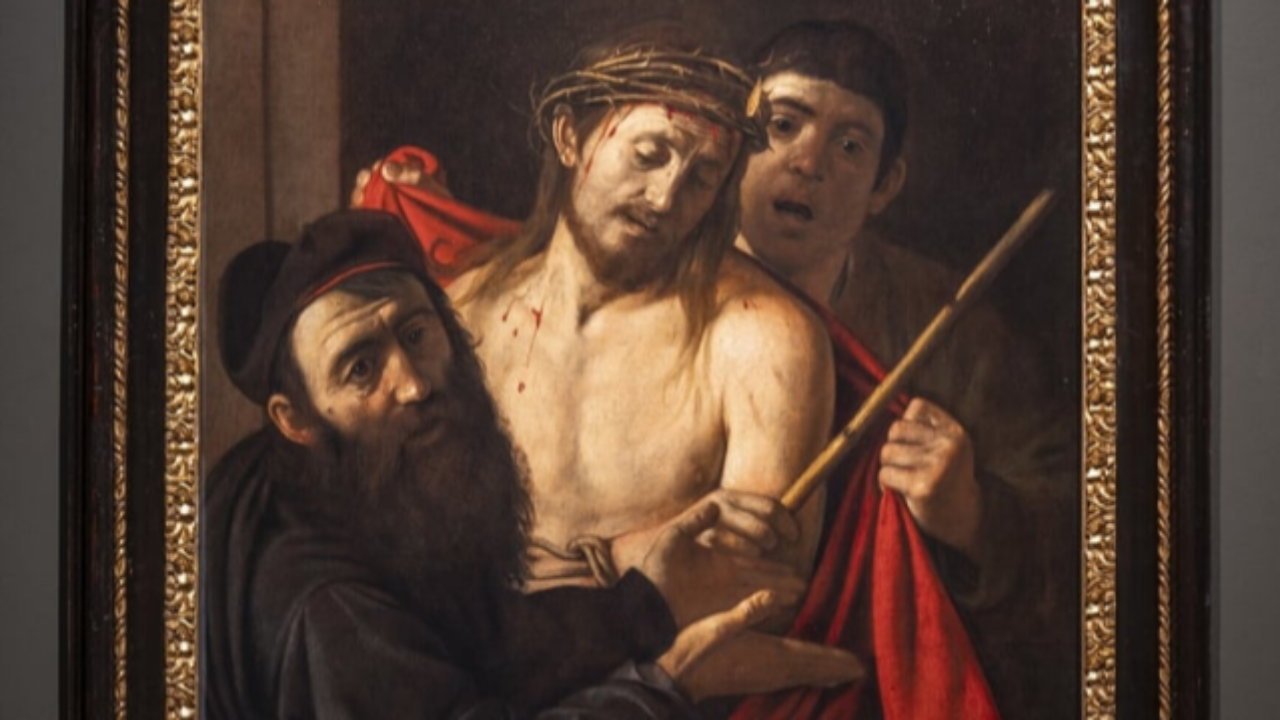
Spain's Prado museum will showcase a newly verified Caravaggio 'Ecce Homo' painting
A painting by the famous Italian Renaissance artist Caravaggio, titled "Ecce Homo", has been unveiled at the Prado Museum in Madrid. The dark canvas depicts a bloodied Jesus wearing a crown of thorns just before his crucifixion, and is one of only around 60 known works by Caravaggio.
The painting was previously mistakenly attributed to an artist belonging to the circle of 17th century Spanish painter Jose de Ribera. A Madrid auction house had been planning to sell the work in April 2021 with an opening price of €1,500.
However, just hours before the auction, the Spanish culture ministry stepped in and blocked the sale, suspecting the painting was actually an authentic Caravaggio. Caravaggio's works are worth millions of euros, so the misidentification would have resulted in the painting being severely undervalued.
The Prado Museum has now officially confirmed the painting's attribution to the renowned Italian master Caravaggio after further investigation and analysis. This rediscovery of a lost Caravaggio work is considered a significant art historical finding.
The ministry action came after the Prado museum sounded the alarm, saying it had "sufficient documentary and stylistic evidence" to suggest that the work was in fact by Michelangelo Merisi da Caravaggio.
The museum announced earlier this month that top experts have determined that the painting is "without a doubt, a Caravaggio masterpiece", calling it "one of the greatest discoveries in the history of art".
Okay, here is the full paraphrased summary incorporating the additional details:
The painting has been restored and will now be displayed to the public for the first time since it was confirmed as an authentic work by the Italian Renaissance master.
The unveiling is taking place at a press conference at the Prado Museum in Madrid. Experts who worked on identifying and restoring the artwork will be participating in the event.
Spanish media have reported that the painting was purchased by a British national living in Spain for the price of €36 million. However, the new owner does not intend to keep the "Ecce Homo" in a private home.
Instead, the buyer wants the painting to join "public collections, for the moment, on loan", as stated by Jorge Coll, the lead of the London art gallery Colnaghi which handled the sale. Coll told Spain's top newspaper El Pais that "the painting is not going to end up in the home of its buyer".
After its initial display at the Prado Museum, the restored Caravaggio work may remain on public exhibition for several more months before potentially being loaned out to other collections.
This rediscovery and public unveiling of a previously unknown Caravaggio painting is considered a major art historical event.
'Had no doubt'
Painted around 1605-1609, the dark and atmospheric canvas is believed to have at one point been part of the private collection of Spain's King Philip IV, before being exhibited in the apartments of his son Charles II.
One of the experts who took part in its authentication, art history professor Maria Cristina Terzaghi of Italian university Roma Tre, told AFP in a 2021 interview that when she saw a picture of the painting sent to her by WhatsApp by some art dealer friends, she "immediately realised it could be very important".
She flew to Madrid to see the canvas and "had no doubt... it was clear it was a work by Caravaggio".
For her, the evidence was ample: from "the head of Christ" to the glow of his torso, the colour of his cloak and "the three-dimensional nature of the three figures, who are offset in a transition that is almost cinematic".
Caravaggio, who had a violent and chaotic life, pioneered the Baroque painting technique known as chiaroscuro, in which light and shadow are sharply contrasted.
Art historians use various methods to determine the legitimacy of an artwork, including forensic examination of the canvas and paint to determine its age, the technology and styles of the era it was created in, and the techniques of the artist or their students.