'Immense' collection of dinosaur footprints found in Italy
Hundreds of metres of dinosaur footprints, complete with toes and sharp claw impressions, have been discovered high in the Italian Alps in an area set to host events during the 2026 Winter Olympics, regional authorities announced on Tuesday.
The remarkable find lies within Stelvio National Park, between the Alpine towns of Bormio and Livigno in northern Italy’s Lombardy region. According to regional president Attilio Fontana, the site represents one of the most extensive collections of dinosaur tracks ever documented in Europe, and possibly worldwide.
The tracks date back more than 200 million years to the Upper Triassic period. They were first noticed in September by nature photographer Elio Della Ferrera, who spotted the imprints on an almost vertical rocky slope while exploring the area. Some of the footprints measure up to 40 centimetres in diameter and stretch across hundreds of metres of exposed rock.
Fontana said the site is exceptional not only for its size but also for what it reveals about dinosaur behaviour. The footprints suggest groups of animals moving together, as well as areas where they appear to have gathered, indicating social interactions rather than random movement.
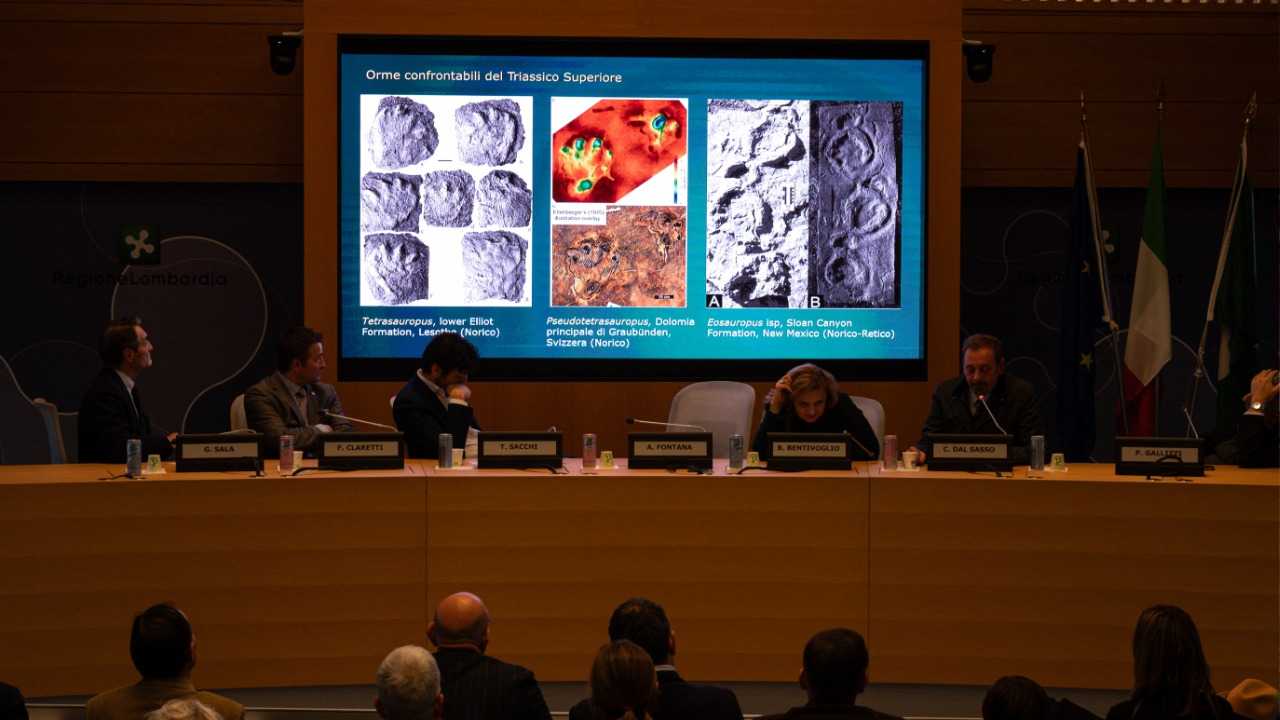
After the initial discovery, Della Ferrera contacted palaeontologist Cristiano Dal Sasso of Milan’s Natural History Museum. Dal Sasso assembled a team of Italian specialists to investigate the site, calling it “an immense scientific heritage.” He noted that parallel trackways provide clear evidence of herds moving in synchrony, while circular groupings of prints may point to defensive behaviour.
Most of the footprints are elongated and appear to have been made by bipedal dinosaurs. The best-preserved tracks show impressions of at least four toes, suggesting they belonged to prosauropods—herbivorous dinosaurs with long necks and small heads that were ancestors of the massive sauropods of the Jurassic period, such as Brontosaurus. Adult prosauropods could grow up to 10 metres long and were equipped with sharp claws. Researchers also believe the site may contain tracks from predatory dinosaurs and archosaurs, the ancestors of modern crocodiles.
Although the prints now appear on a steep slope, experts explained that when the dinosaurs walked there, the area consisted of vast tropical tidal flats surrounding the ancient Tethys Ocean. The tracks formed in soft, waterlogged mud, which preserved fine anatomical details before being buried by sediments. Millions of years later, the uplift of the Alps and erosion brought them back to light.
Geologist Fabrizio Berra described the overlapping layers as “like reading the pages of a stone book,” offering a rare window into ancient life and environments over time.