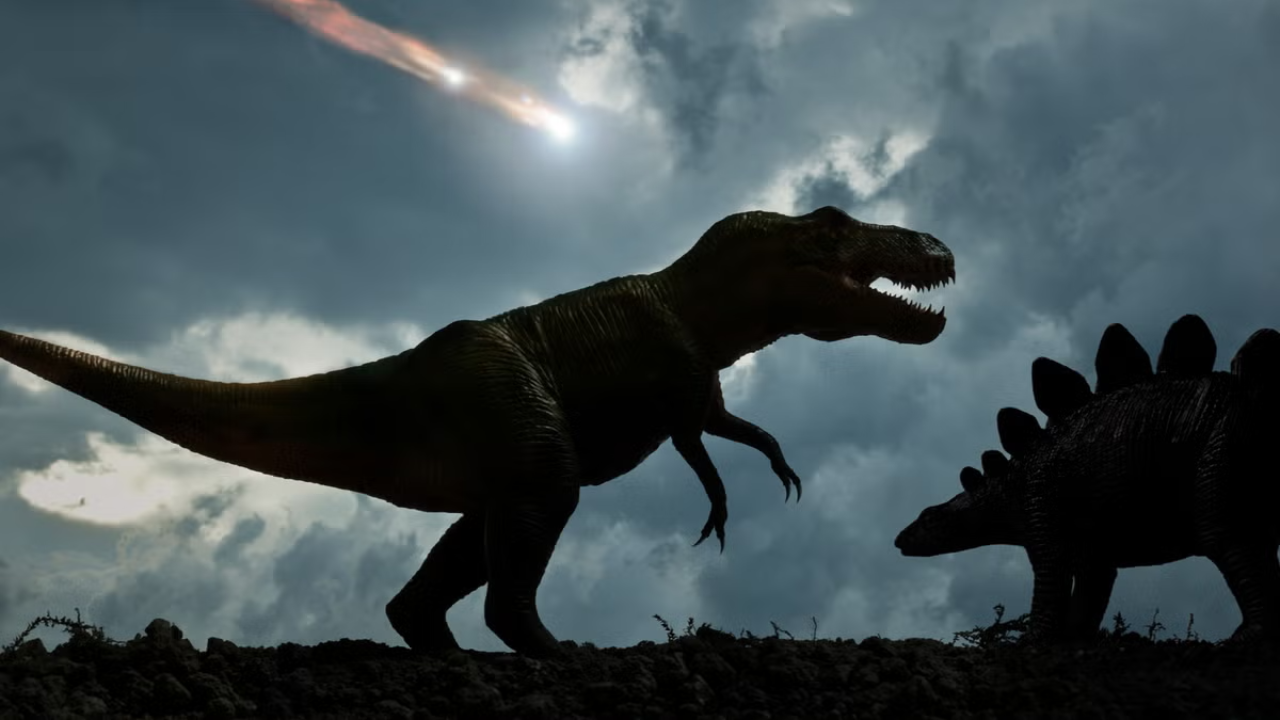
New study reveals dinosaurs thrived just before asteroid impact, challenging decline theories
A recent study has revealed that a fossil site in New Mexico, known as Naashoibito, contains numerous dinosaurs, including the massive Alamosaurus, dating back to approximately 340,000 years before the asteroid impact that marked the end of the dinosaurs' reign 66 million years ago. This research highlights that these creatures were thriving just before the catastrophic event.
Paleontologists have long debated the age of the fossils at Naashoibito. The new study employed two dating methods: one based on the orientation of Earth's magnetic field recorded in the rocks, and another that measured the decay of radioactive isotopes in sand grains found at the site. These methods provided clarity on the site's dating, establishing it as a significant time just before the Cretaceous Period's end.
The study counters earlier beliefs that dinosaurs were in decline prior to the asteroid strike. Instead, it presents evidence that supports the notion of a diverse and abundant dinosaur community. The Naashoibito fossils include a variety of dinosaurs that occupied different ecological niches, with Alamosaurus being one of the largest known sauropods, weighing over 30 tons and reaching lengths of approximately 100 feet (30 meters).
Other notable dinosaurs from the site include the apex predator Tyrannosaurus, the horned dinosaur Torosaurus, along with various duck-billed and armored dinosaurs, as well as bird-like species.
The study also highlighted differences between the dinosaur communities in southern North America, represented by Naashoibito, and those in the northern regions, as evidenced by fossils from the Hell Creek formation in Montana, North Dakota, South Dakota, and Wyoming. While certain species like Tyrannosaurus and Torosaurus were shared between the two areas, notable distinctions existed, such as the absence of sauropods in the north and variations among duck-billed dinosaurs.
Paleontologist Dan Peppe from Baylor University, a co-author of the study published in Science, emphasized that dinosaurs were not a uniform group susceptible to extinction but were instead diverse and thriving leading up to the end of the Cretaceous. Steve Brusatte, a paleontologist from the University of Edinburgh and co-author, added that these dinosaurs showed no signs of distress or long-term decline, continuing to adapt and thrive in their environments as they had for over 150 million years.