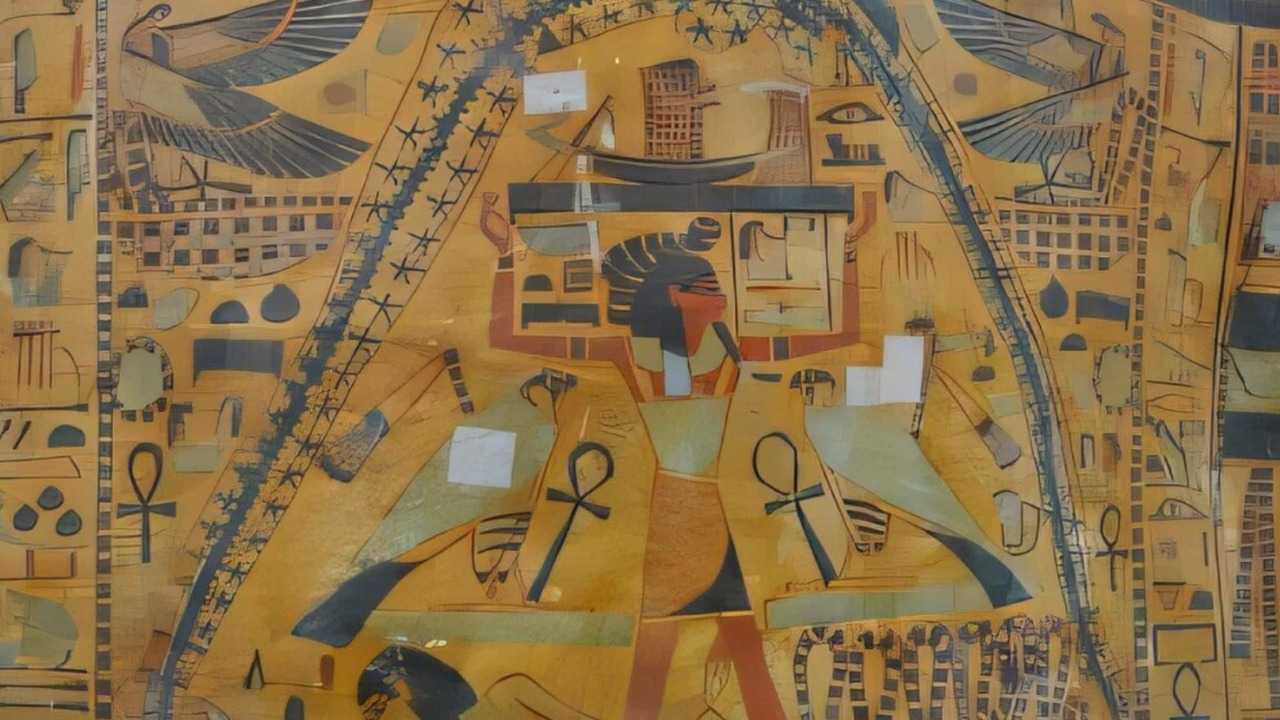
Depictions of the Milky Way in Ancient Egyptian Imagery
Dr. Or Graur, an Associate Professor of Astrophysics at the University of Portsmouth, has explored the significance of the Milky Way in ancient Egyptian culture. His research suggests that ancient Egyptians may have visually represented the Milky Way through their depictions of the sky-goddess Nut. In his study, Dr. Graur analyzed 125 images of Nut from 555 ancient coffins dating back nearly 5,000 years, merging astronomy with Egyptology.
According to Phys Org, Nut is often portrayed as a star-covered, arched woman who embodies the sky and protects the Earth below. She is depicted in scenes of both day and night, illustrating her connection to the solar cycle—swallowing the sun at dusk and birthing it at dawn. However, a unique depiction on the coffin of Nesitaudjatakhet, a chantress of Amun-Re from about 3,000 years ago, features an unusual black curve crossing her body, with stars painted both above and below.
Dr. Graur believes this curve symbolizes the Milky Way, possibly representing the Great Rift, a dark band of dust within the galaxy. He noted the resemblance between this depiction and photographs of the Milky Way. Additionally, similar curves appear in four tombs in the Valley of the Kings. For instance, in Ramesses VI's tomb, the ceiling displays arched figures of Nut with thick, golden curves that extend from her head across her back.
Dr. Graur emphasizes that while there is a connection between Nut and the Milky Way, they are not identical. Nut serves as a canvas for various celestial phenomena, including the Milky Way, which enhances her role as the sky. In a previous study, he examined ancient texts such as the Pyramid Texts and Coffin Texts, suggesting that the Milky Way highlighted Nut's arms in winter and traced her spine in summer.
His findings have evolved, showing that visual representations provide a richer understanding of the relationship between Nut and the Milky Way. Both studies are part of a broader project to explore the multi-cultural mythology of the Milky Way. Dr. Graur's interest in Nut was sparked during a museum visit with his daughters, who were fascinated by her image, prompting him to delve deeper into this captivating aspect of ancient Egyptian mythology.