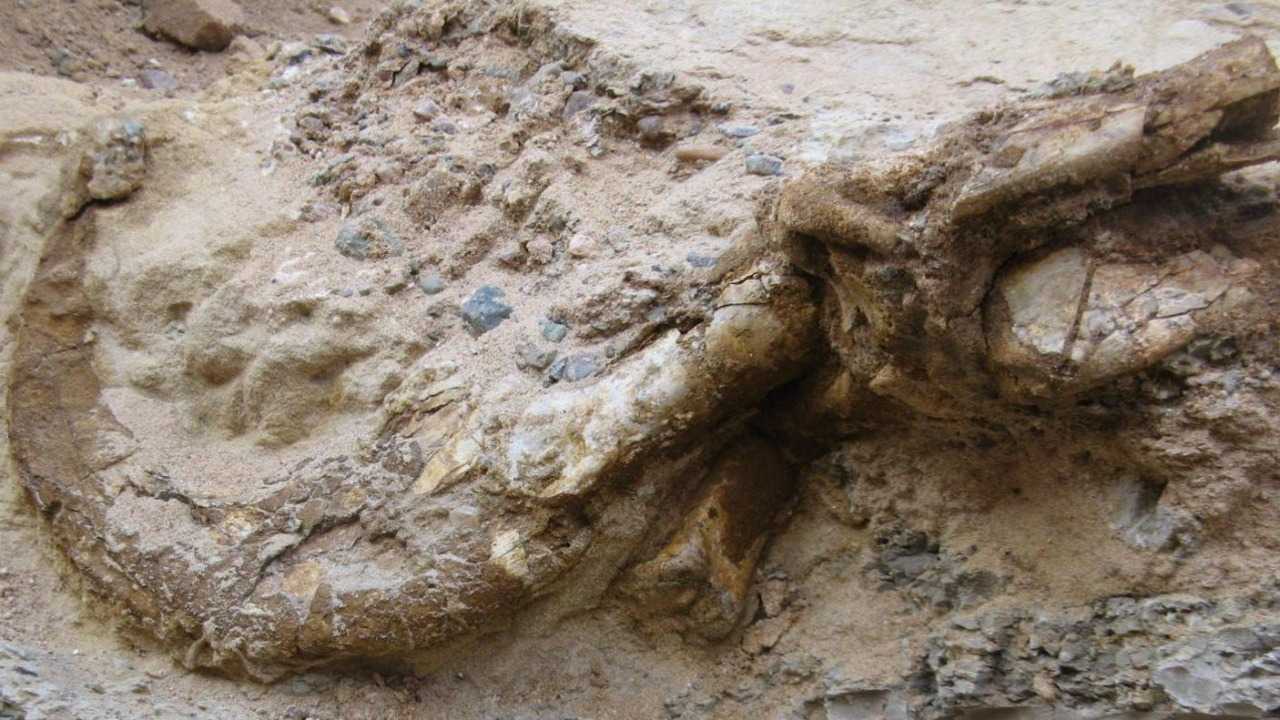
Fossils from Mongolia unearth odd dinosaur Duonychus with menacing claws
Fossils uncovered during the construction of a water pipeline in the Gobi Desert of Mongolia have revealed a unique dinosaur named Duonychus tsogtbaatari.
This dinosaur, measuring about 10 feet (3 meters) long and weighing approximately 575 pounds (260 kg), lived around 90 to 95 million years ago during the Cretaceous Period. Notably, Duonychus features two-fingered hands equipped with menacing, curved claws that measure about a foot (30 cm) long.
Duonychus is classified as a medium-sized member of the therizinosaurs, a peculiar group of dinosaurs characterized by a rotund torso, long neck, small head, bipedal stance, feathers covering the body, and massive claws on the hands.
Although therizinosaurs belong to the theropods clade, which includes carnivorous dinosaurs like Tyrannosaurus and Spinosaurus, they primarily consumed plants.
What sets Duonychus apart from other therizinosaurs is its two-fingered hands, as all previously known therizinosaurs had three clawed fingers.
The name Duonychus translates to "two claw," reflecting this distinctive feature.
Paleontologist Yoshitsugu Kobayashi from Hokkaido University Museum described therizinosaurs as “some of the weirdest dinosaurs ever,” noting their resemblance to giant feathered sloths.
He remarked that Duonychus further exemplifies this oddity with its short, two-fingered hands and claws similar to those of raptors, yet used for foraging on plants.
The individual specimen of Duonychus was not fully grown and lived in a semi-arid environment alongside various other dinosaurs, including armored dinosaurs, horned dinosaurs, and the smaller Alectrosaurus, a forerunner of Tyrannosaurus.
Despite the skeleton being incomplete—missing its skull and legs—the arms and hands were well-preserved.
Notably, one of its claws retained an outer covering of keratin, the same material found in human fingernails.
This keratin sheath added over 40% to the claw's length, providing invaluable insights into how these dinosaurs utilized their hands in life.
Co-author Darla Zelenitsky from the University of Calgary emphasized the rarity of such keratin fossilization, which offers an extraordinary glimpse into the functional anatomy of these dinosaurs.
The well-preserved hands exhibit intricate details, including fused wrist bones and stiff joints, indicating that the claws may have served multiple purposes, primarily for grasping and pulling down branches to access leaves.
The discovery of Duonychus tsogtbaatari not only enriches our understanding of therizinosaurs but also highlights the diverse adaptations that evolved in dinosaurs throughout the Cretaceous Period.