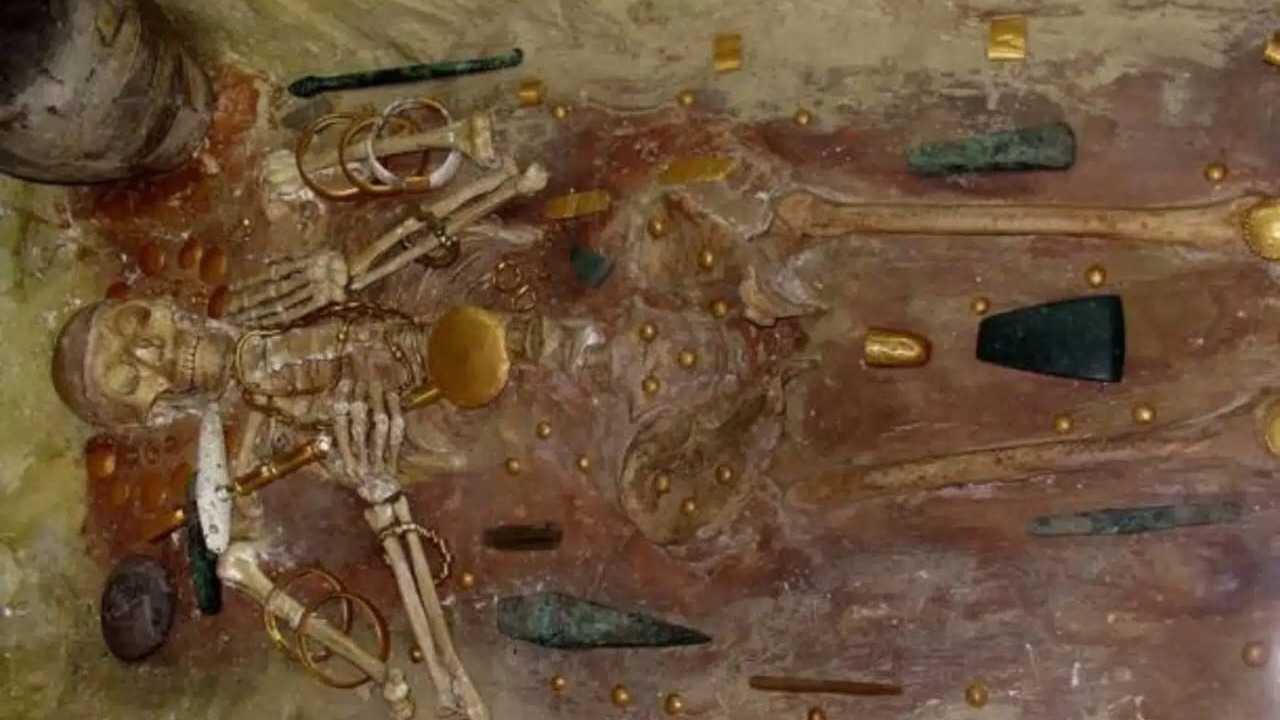
Oldest Golden Artifacts Discovered in a 5th Millennium BC Grave
In the 1970s, archaeologist Raycho Marinov uncovered one of Bulgaria's most significant discoveries: the wealthiest grave from the 5th millennium BC, containing the oldest known golden artifacts. This discovery, in the vast Copper Age necropolis, revealed a complex society with varying burial practices. Some graves were filled with treasures like gold jewelry, copper axes, and decorative ceramics, while others featured simple burials with minimal goods. Notably, some graves contained no skeletons at all—these ‘symbolic graves,’ or cenotaphs, were the richest, often containing human-sized clay masks placed where the deceased’s head would have been.
Among these graves, Grave 43 stood out for its remarkable golden artifacts, revealing the burial of a high-status male, likely a ruler or leader. This individual was buried with abundant gold, far beyond the usual amount found in other graves. The discovery highlighted the highly stratified nature of the Varna culture, with elite members buried in shrouds adorned with gold ornaments sewn into cloth.
According to Greek Reporter, from 1972 to 1991, extensive excavations directed by Mihail Lazarov and Ivan Ivanov unearthed over 22,000 artifacts, including more than 3,000 pieces of gold weighing 6 kilograms (13.23 pounds). The artifacts, ranging from stone tools to Mediterranean shells, provided the first evidence of Varna’s advanced civilization. These discoveries revealed a society with a rich belief system, intricate funerary practices, and significant trade connections, including with the Black Sea and Mediterranean regions.
The Varna culture, older than the empires of Mesopotamia and Egypt, was the first to craft golden artifacts, marking the beginning of goldsmithing between 4600 and 4200 BC. Metallurgists who mastered copper and gold metallurgy played a crucial role in the society's prosperity. The region’s strategic location near a deep bay allowed it to flourish as a major trade center, leading to an emerging societal hierarchy with metallurgists at the top, followed by merchants and farmers.