'Extremely exciting': the ice cores that could help save glaciers
Dressed in a bright orange puffer jacket, Japanese scientist Yoshinori Iizuka carefully stepped into a storage freezer to retrieve an ice core that could hold vital clues for protecting the world’s rapidly disappearing glaciers. The fist-sized sample, drilled from a mountaintop in Tajikistan, is part of an ambitious international effort to understand why glaciers in the region have resisted the rapid melting affecting almost everywhere else.
“If we can uncover the mechanism behind the increased volume of ice here, it might be possible to apply that knowledge to other glaciers around the world,” said Iizuka, a professor at Hokkaido University. “That may sound ambitious, but ultimately, I hope our study will help people.”
Glaciers are vanishing at alarming rates, with thousands expected to disappear each year in the coming decades. By the end of this century, only a fraction may remain unless global warming is curbed, according to a study published Monday in Nature Climate Change.
Earlier this year, AFP accompanied Iizuka and his team through harsh conditions to the Kon-Chukurbashi ice cap in the Pamir Mountains, at an altitude of 5,810 meters (about 19,000 feet). This area is unique: it is the only mountainous region in the world where glaciers have not only resisted melting but have even slightly grown, a phenomenon known as the “Pamir-Karakoram anomaly.”
At the site, the team drilled two ice columns approximately 105 meters (345 feet) long. One column will be stored in an underground sanctuary in Antarctica maintained by the Ice Memory Foundation, which, along with the Swiss Polar Institute, supported the Tajikistan expedition. The other was sent to Iizuka’s lab at the Institute of Low Temperature Science at Hokkaido University in Sapporo. There, researchers are investigating why precipitation has increased in the region over the past century and how the glacier has remained resilient.
Some scientists speculate that the anomaly could result from the area’s cold climate or from increased agricultural water use in Pakistan, which generates additional atmospheric moisture. However, the ice cores provide the first opportunity to study the anomaly scientifically.
“Information from the past is crucial,” Iizuka said. “By understanding how snow has continuously accumulated over the centuries, we can clarify what may happen in the future and why the ice has grown.”
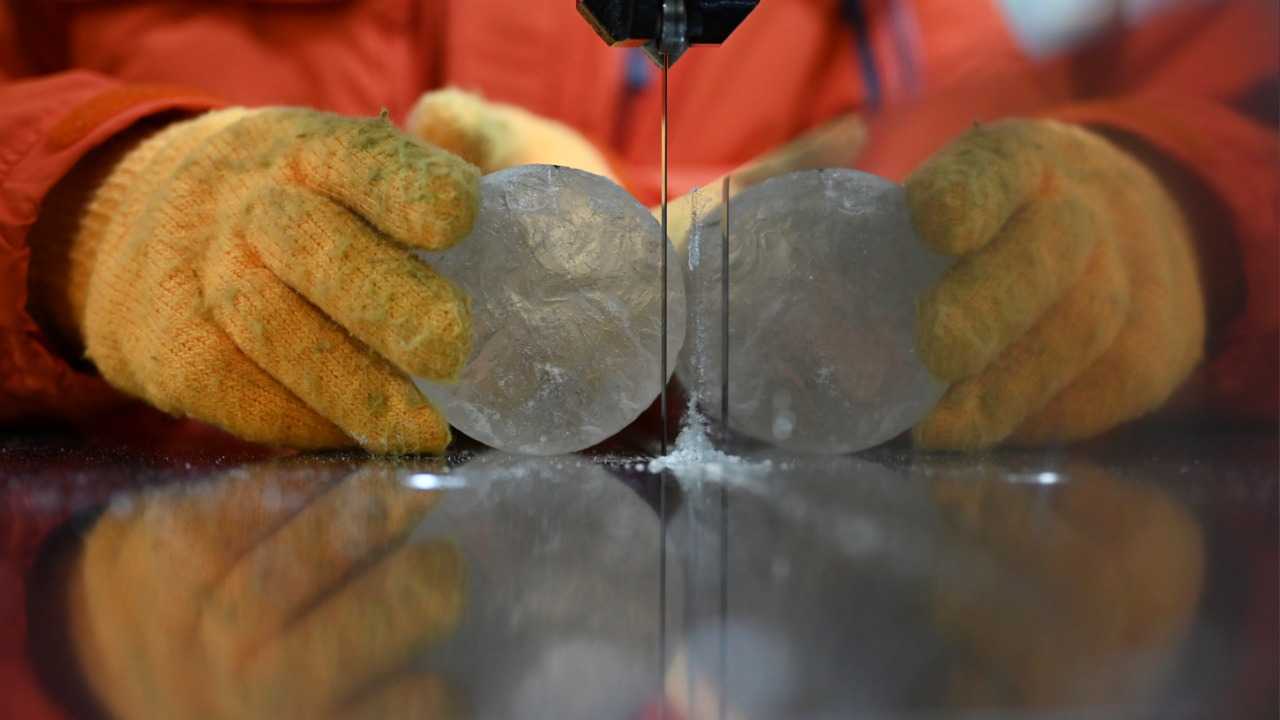
Since the samples arrived in November, his team has worked in freezing storage facilities, logging the density of the ice, the alignment of snow grains, and the structure of ice layers. In December, AFP observed the researchers in their minus-20°C lab, dressed like polar explorers, cutting and shaving ice samples with meticulous care.
Each layer of the ice tells a story. Clear ice layers indicate periods when the glacier melted and refroze, while low-density layers reveal packed snow that helps estimate precipitation. Cracks or brittle sections indicate snowfall on half-melted layers that later froze again. Volcanic materials, such as sulfate ions, serve as time markers, and water isotopes can reveal historical temperatures.
Iizuka hopes the cores contain ice dating back 10,000 years or more, despite a warm spell around 6,000 years ago that melted much of the glacier. “Ancient ice could help us understand what kind of snow fell here 10,000 years ago and what particles were suspended in the atmosphere during that time,” he said.
The work proceeds slowly and carefully. Graduate student Sora Yaginuma, for example, meticulously slices the ice to prepare it for multiple analyses. “An ice core is extremely valuable and unique,” Yaginuma explained. “From a single core, we conduct a wide range of chemical and physical analyses.”
The team expects to publish its first findings next year and will rely heavily on trial-and-error to reconstruct past climate conditions. The samples preserved in Antarctica will offer opportunities for further research, including studying how historical mining affected air quality, temperature, and precipitation in the region.
“With so many secrets waiting to be uncovered, this research is extremely exciting,” Iizuka said. “It allows us to learn how the Earth’s environment has changed in response to both natural and human influences.”